
What is HIPAA Compliance? A Beginner's Guide
Must Read
Must Read
For any organisation operating in or adjacent to the US healthcare ecosystem, HIPAA is not an optional consideration. The Health Insurance Portability and Accountability Act sets the legal standard for how protected health information must be handled, and the businesses that discover this requirement late, usually after a breach or a compliance audit, tend to find the learning process expensive.
Understanding what HIPAA actually requires, who it applies to, and what genuine compliance looks like is the starting point for any organisation that touches healthcare data in any capacity.
HIPAA is a US federal law enacted in 1996 that establishes national standards for protecting sensitive patient health information. At its core it is meant to prevent the unauthorised access, use and disclosure of personal health data including medical records, diagnoses, treatment histories and insurance information without sufficient safeguards and in most cases patient consent.
The regulation has developed considerably since it was first enacted, with follow-on rules extending its scope and intensifying its obligations related to security and breach notification. Today, HIPAA is a complete framework for businesses managing health data that tackles privacy, security and incident response duties all at once.
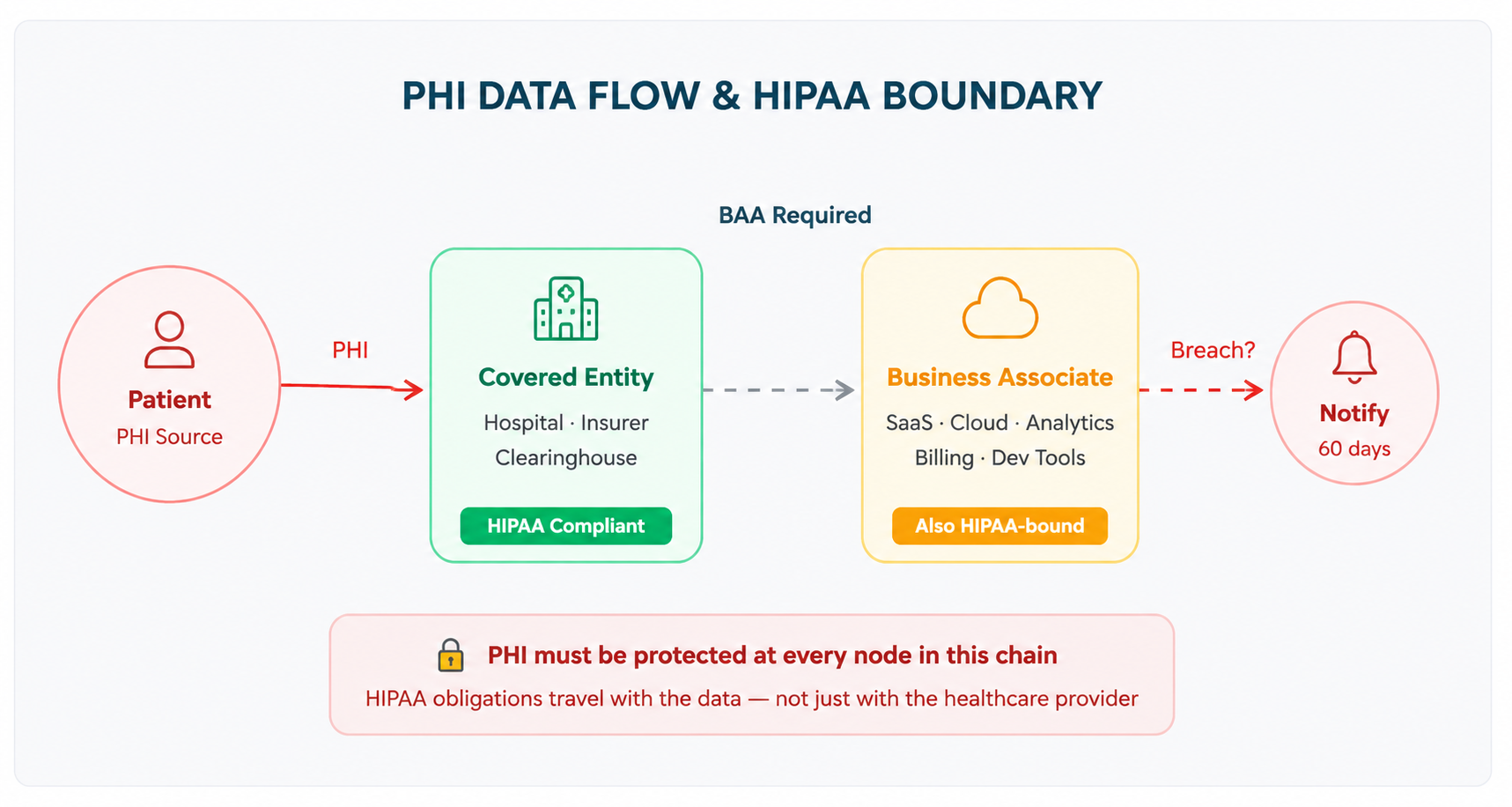
HIPAA applies to two broad categories of organisations.
That second category is broader than many organisations initially assume. A cloud storage provider hosting medical records, a software company building a patient management system, a billing service processing insurance claims, a data analytics firm working with healthcare datasets, all of these fall within HIPAA's scope.
The regulation follows the data, not just the primary healthcare relationship.
PHI stands for Protected Health Information. PHI is individually identifiable health information that is created, received, stored or transmitted by a covered entity or business associate. The definition covers a wide range of data types:
Medical records and diagnoses
Health insurance details
Billing information linked to healthcare
Treatment histories
Name, date of birth, address
Contact details tied to health data
Any re-identifiable combination of fields
Device identifiers and IP addresses
An anonymised dataset that retains enough data points to allow re-identification still qualifies as PHI under HIPAA's standards. Organisations that assume de-identification provides automatic protection without meeting HIPAA's specific de-identification criteria are operating on a misconception that creates real compliance risk.
HIPAA compliance is structured around three principal rules, each addressing a distinct dimension of health data protection.
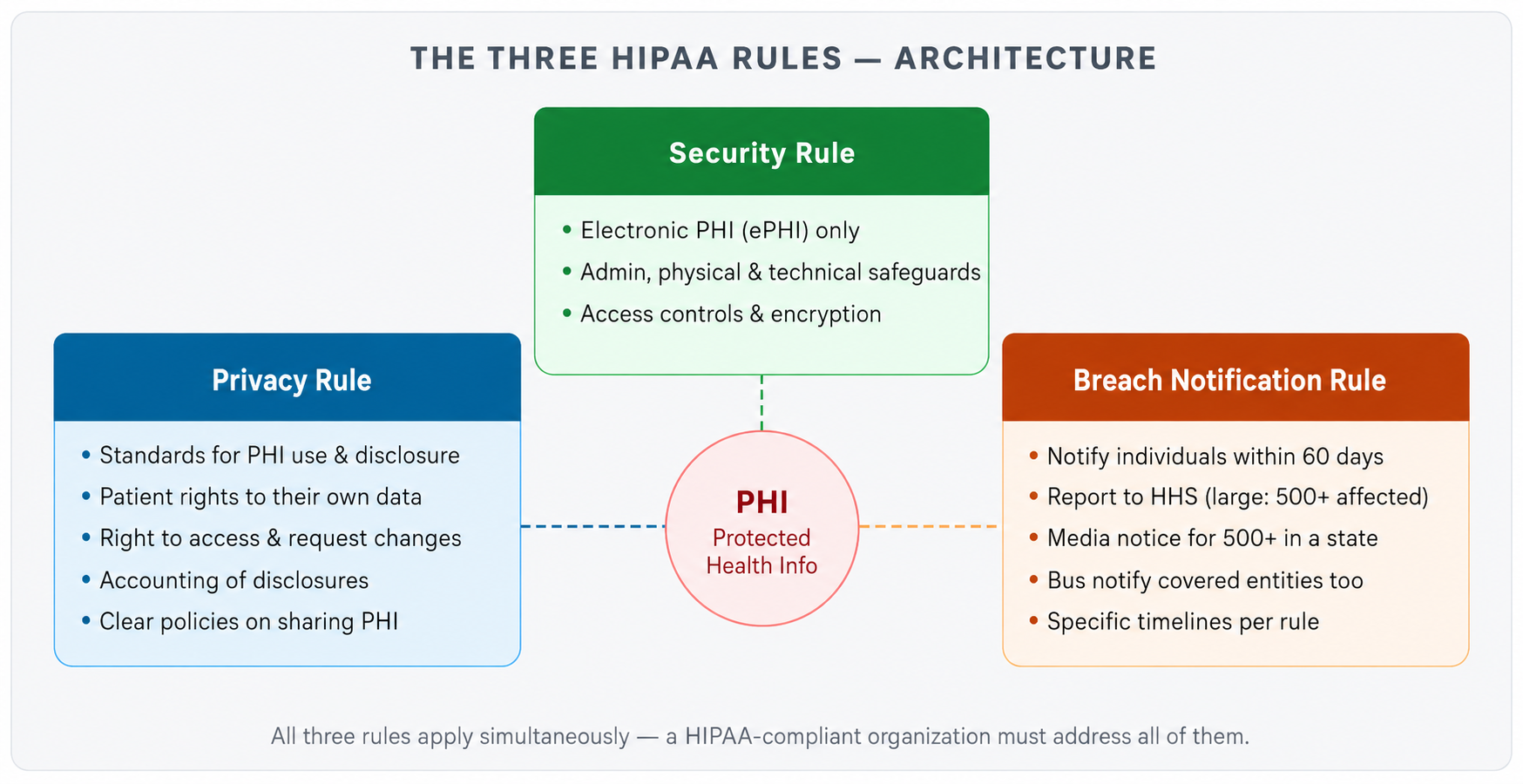
The Privacy Rule
It establishes the standards for how PHI can be used and disclosed. It grants patients rights to their own health information, such as the right to see their data, the ability to request modifications, and the right to an accounting of disclosures. Organisations need clear policies on when and how PHI may be shared and with whom.
The Security Rule
It only applies to electronic PHI, and requires covered companies and business associates to maintain administrative, physical and technical protections to preserve it. These include access controls, encryption, audit logging, staff training and documented security policies. The Security Rule does not prescribe specific technologies but requires safeguards appropriate to the organisation's size, complexity, and the sensitivity of the data it handles.
The Breach Notification Rule
It requires covered entities to notify affected individuals, the Department of Health and Human Services, and in some cases the media when a breach of unsecured PHI occurs. Notification timelines are specific, affected individuals must generally be notified within sixty days of a breach being discovered. Business associates have their own notification obligations to the covered entities they serve.
The challenges organisations run into with HIPAA compliance are less about understanding the requirements and more about sustaining them operationally over time.
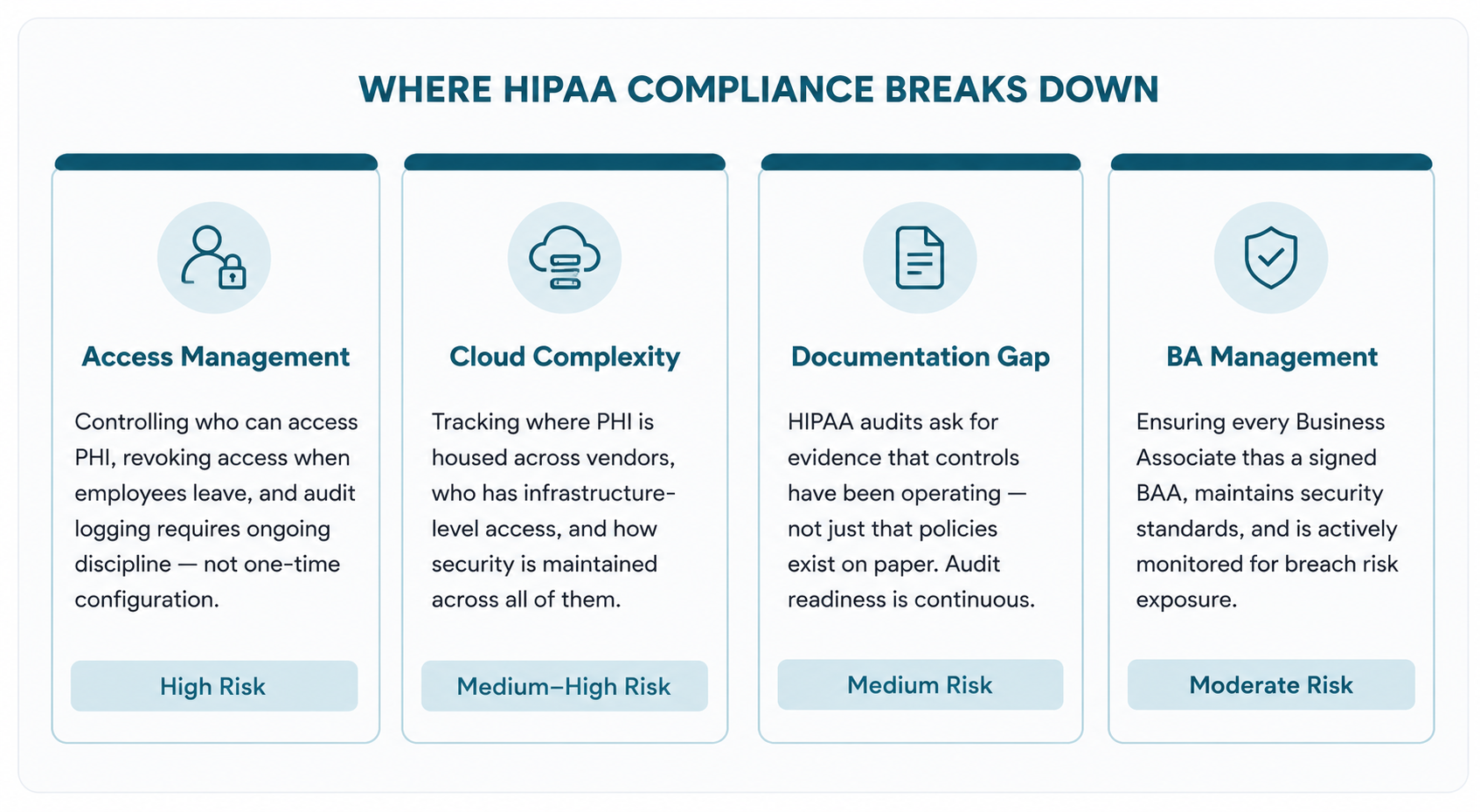
Access management is a persistent gap, controlling who can access PHI, ensuring access is revoked when employees leave or change roles, and maintaining audit logs that demonstrate access controls are functioning requires ongoing operational discipline rather than a one-time configuration.
With cloud and digital systems, the complexity of where data is housed, who has access at the infrastructure level and how security measures are maintained across vendors exists. Documentation and audit readiness require continuous effort, HIPAA audits and breach investigations will ask for evidence that controls have been operating effectively, not just that policies exist on paper.
HIPAA penalties are tiered based on the level of culpability, ranging from $100 per violation for unknowing violations to $50,000 per violation for wilful neglect that is not corrected, with annual caps per violation category.
Beyond the financial penalties, a publicly reported HIPAA breach damages patient trust in ways that are difficult to quantify and slow to rebuild, particularly for healthcare technology companies where data security is a core part of the commercial proposition.
Organisations that approach HIPAA compliance as a continuous operational function — rather than a one-time implementation — are the ones that sustain it without recurring crises.
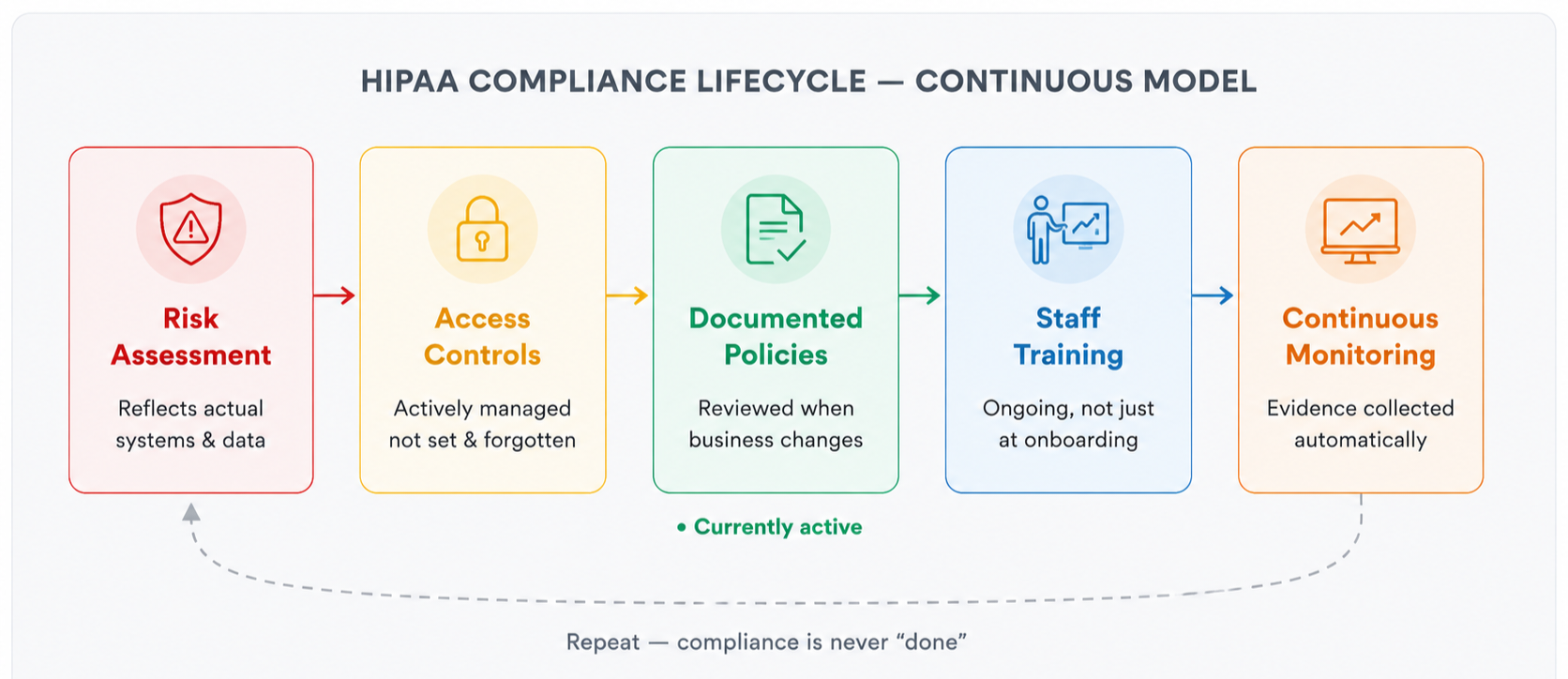
Regular risk assessments that reflect the actual current state of systems and data flows, access controls that are actively managed rather than set and forgotten, documented policies that are reviewed and updated when the business changes, and ongoing staff training that keeps security awareness current — these are the operational habits that separate organisations that sustain HIPAA compliance from those that scramble before every audit.
Organisations that approach HIPAA compliance as a continuous operational function, rather than a one-time implementation, are the ones that sustain it without recurring crises. Regular risk assessments that reflect the actual current state of systems and data flows, access controls that are actively managed rather than set and forgotten, documented policies that are reviewed and updated when the business changes, and ongoing staff training that keeps security awareness current rather than treating it as a box checked at onboarding.