
Why Compliance Becomes a Bottleneck in Scaling Startups
Recommended
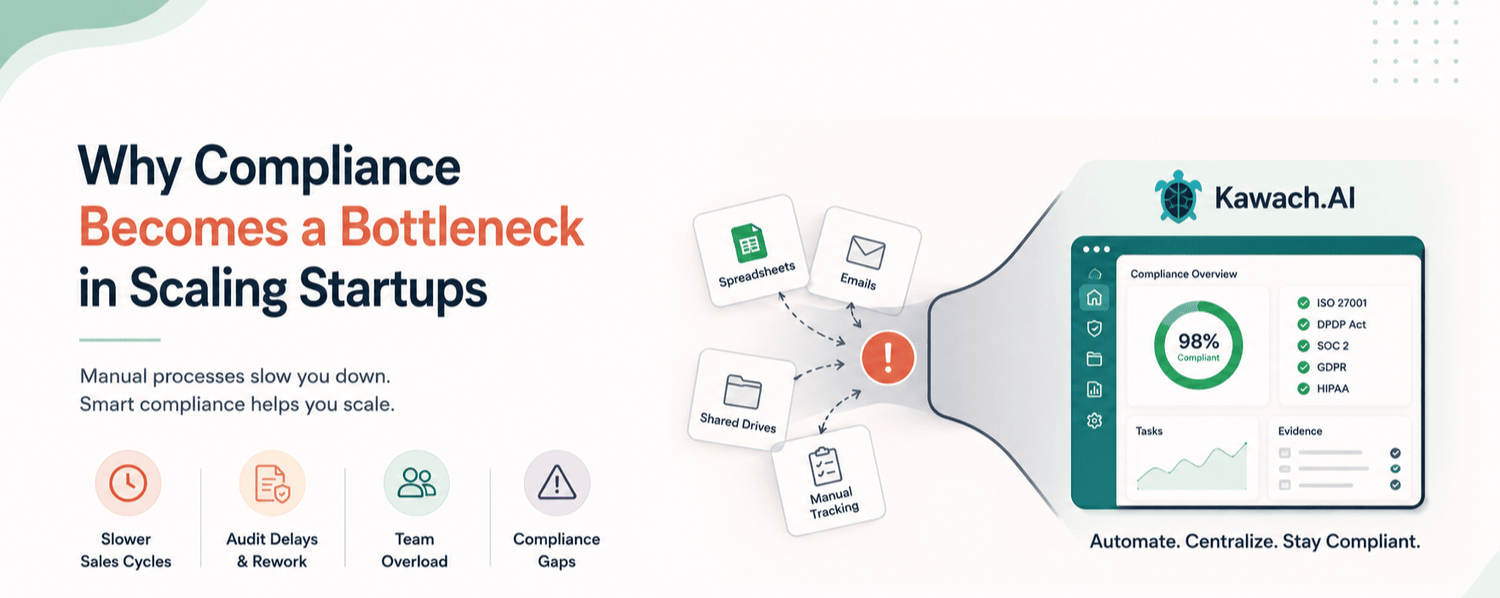
Recommended
There is a specific inflexion point that most scaling startups hit, somewhere between twenty and fifty people, where compliance stops being a background concern and starts actively getting in the way.
Enterprise sales conversations stall because security questionnaires take two weeks to complete. ISO 27001 certification, which was supposed to take three months, is running at seven. A new client's vendor onboarding requires documentation that nobody has maintained consistently. The DPDP Act is somewhere on the legal team's radar, but nobody owns it operationally.
None of these are catastrophic individually — together, they create a pattern where compliance is perpetually absorbing time and attention that should be going toward growth. The manual processes that felt adequate at ten people are visibly failing at forty.
The compliance bottleneck in scaling startups rarely has a dramatic origin. It builds from a series of reasonable decisions made at an earlier stage, when the compliance workload was light enough that manual processes genuinely worked.
The problem is that compliance complexity scales with the business in ways that manual processes cannot absorb. More customers means more vendor security assessments. More data means more DPDP obligations. More frameworks means more duplication of effort across trackers that were never designed to talk to each other. Each new requirement adds to the load carried by a system that was already operating close to capacity.
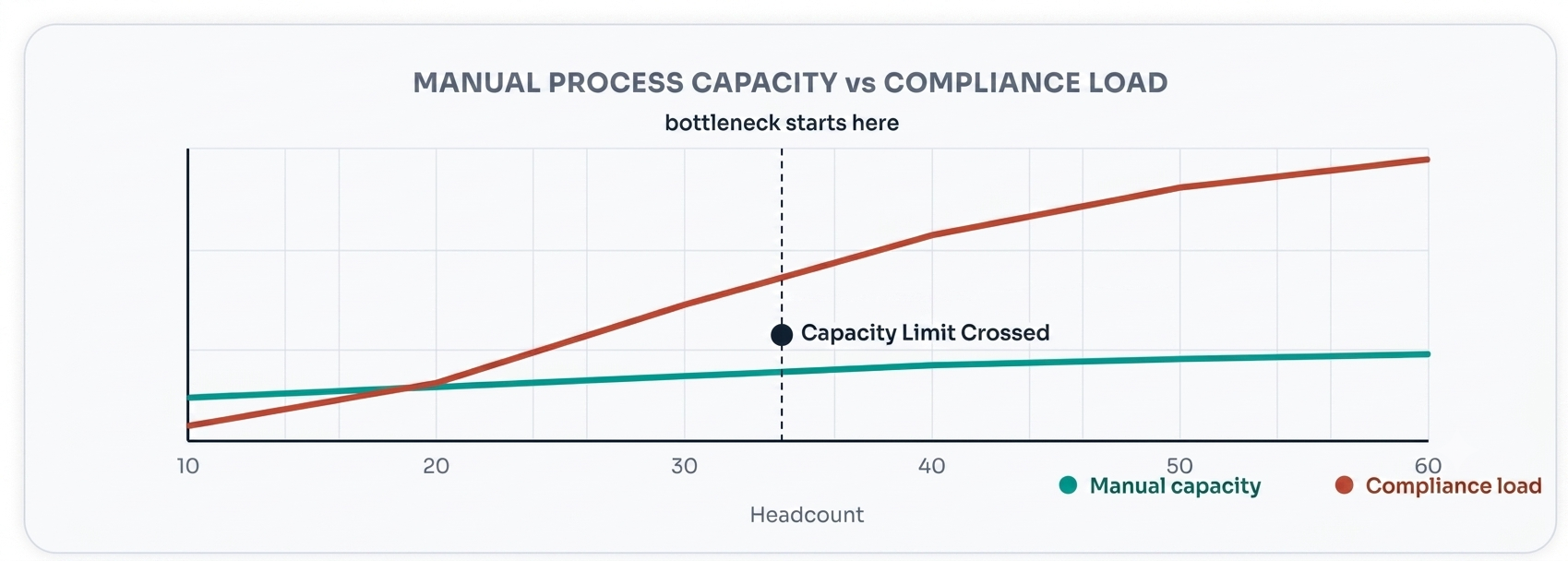
The compliance bottleneck manifests in places that have direct commercial consequences, which is what distinguishes it from the kind of operational inefficiency that can be tolerated while the business grows.
Enterprise prospects require security documentation, compliance certifications, and evidence of data governance practices before contracts can progress. A startup that cannot respond to a security questionnaire quickly — because the answers require pulling information from multiple people, multiple systems, and multiple documents that may or may not be current — loses time in sales cycles that compounds across every deal.
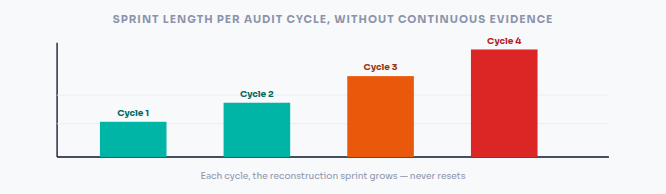
ISO 27001 certification and DPDP compliance reviews both require evidence that has been collected continuously, not assembled retrospectively. When the evidence collection process has been inconsistent, audit preparation becomes a reconstruction exercise that takes far longer than it should and produces documentation that holds up less well under scrutiny.
As startups move through funding rounds, the compliance questions get harder and more specific. Investors conducting due diligence on a Series B candidate will ask detailed questions about data governance, security controls, and regulatory compliance. A startup that cannot answer those questions clearly and quickly raises concerns that go beyond the compliance function itself.
When compliance is managed manually by people who have other primary responsibilities, the workload becomes unsustainable as the requirements grow. The CTO who started managing ISO controls as a side function is now spending two days a week on compliance administration. The cost is not just the compliance work itself — it is the strategic and product work that is not getting done because the bandwidth is consumed.
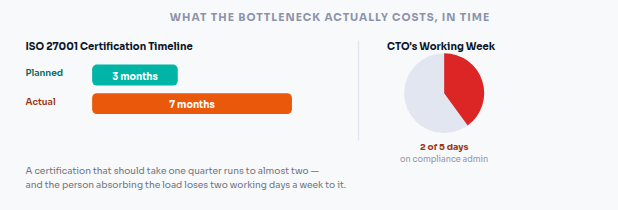
The structural limitations of manual compliance management are consistent regardless of how carefully the spreadsheets are designed or how diligent the team is.
A compliance tracker reflects what was entered at the last update, which is always in the past and often significantly so. Gaps and lapsed controls do not surface automatically — they surface when someone reviews the tracker, which happens infrequently and usually under pressure.
The manual effort required to maintain compliance documentation grows faster than the business itself. Adding a new framework does not just add incremental work; it adds coordination overhead, duplication across existing trackers, and additional dependencies on people who are already stretched.
Because evidence is not being collected continuously, every audit requires a concentrated period of reactive work that disrupts normal operations. That sprint gets longer and more stressful with each audit cycle, not shorter.
The startups that eliminate compliance as a growth bottleneck do so by treating it as an operational function with proper infrastructure, rather than a task that gets done through individual effort and organisational willpower.
Centralising compliance management across frameworks — DPDP, ISO 27001, and client security requirements — in a single platform removes the duplication and coordination overhead that currently consumes disproportionate time
Automated evidence collection — means the documentation required for audits exists before the audit window opens
Real-time visibility into compliance status — means gaps surface when they can be addressed quietly, not when they have become findings
Standardised processes — mean the work is not dependent on the availability of one or two individuals who carry the institutional knowledge
Compliance becomes a bottleneck in scaling startups because the manual processes that worked at an earlier stage were never designed to handle the volume, complexity, and commercial stakes that come with growth.
The startups that scale without this friction are the ones that invested in proper compliance infrastructure before the bottleneck formed, making the function scalable by design rather than discovering its limits under pressure.